Choosing an Aluminium Door With Window in 2026 requires more than comparing frame colours and online prices. A reliable choice must balance thermal performance, security, daylight, ventilation, weather resistance, and long-term maintenance. The right door should feel solid when it closes, remain quiet during strong wind, and keep the floor near the threshold dry after heavy rain.
Fenestration consultant Helen Sanders offers a useful principle: “A door should protect the room before it decorates the entrance.” Her point is practical. An attractive aluminium frame cannot compensate for poor installation, weak hardware, or unsuitable glass. Buyers should examine the U-value, glass specification, drainage design, lock system, hinge quality, and warranty terms. In colder regions, thermal breaks and low-emissivity double or triple glazing may significantly improve comfort. In warmer climates, solar-control glass can reduce glare and indoor heat.
This guide examines how these details affect real homes, apartments, offices, and renovation projects. It also considers frame depth, opening direction, threshold height, and accessibility. A narrow threshold may look clean, yet it can require better drainage and careful fitting. A larger glass panel brings more daylight, but it may reduce privacy or increase overheating.
There is no perfect specification. I might prioritize insulation, while another homeowner values uninterrupted garden views. The best Aluminium Door With Window is the one matched to the building, local climate, daily use, and installer’s experience. Small details matter. A few overlooked millimetres can become years of drafts, sticking locks, or water damage.
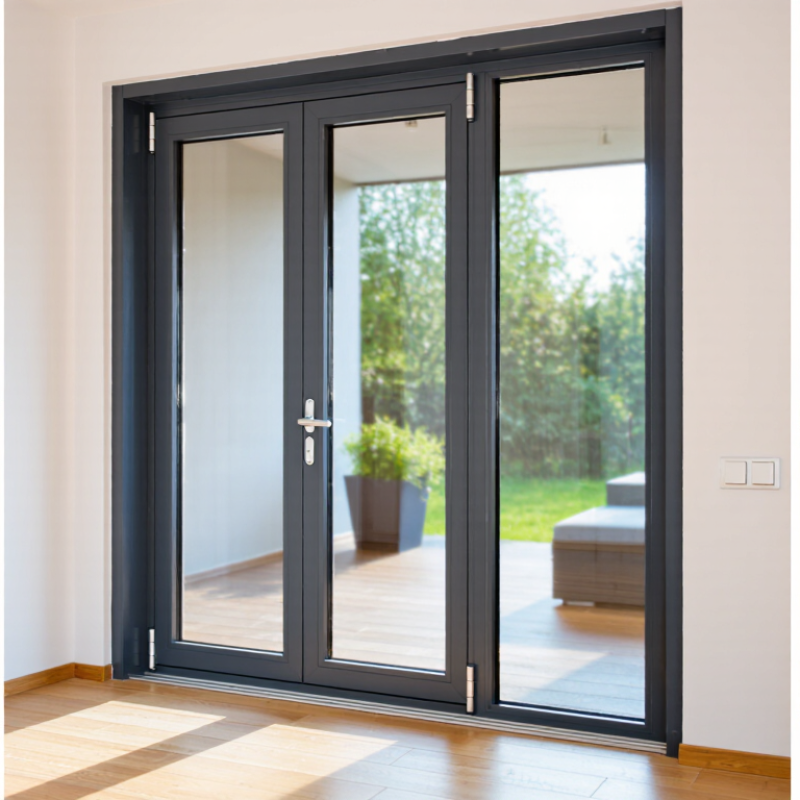
Choosing an aluminium door with window starts with its purpose, not its appearance. An entrance door needs security, weather resistance, and a welcoming sightline. A kitchen door may need daylight and quick access to a garden. An internal door can prioritize visibility and ventilation instead.
Study the placement carefully. A south-facing opening may receive strong afternoon heat, while a shaded hallway needs more glass for brightness. Measure the wall opening, floor level, nearby furniture, and door swing. Leave enough clearance for bags, furniture, and daily movement. Small details matter.
Privacy also changes the glass choice. A bathroom-facing door should avoid clear glazing. Frosted or textured glass can preserve light without exposing the room. For a street-facing entrance, check what visitors can see from the pavement. That view is easy to overlook.
I once saw a beautiful glazed door placed beside a narrow walkway. Its swing blocked movement and scratched the adjacent wall. The design looked right on paper, but the placement was wrong. A sliding option might have worked better, although it can require more complex installation and maintenance.
Ask a qualified installer to inspect drainage, threshold height, frame alignment, and local building requirements. Aluminium frames are durable, but poor sealing can still cause drafts or water problems. Review the site at different times of day. Morning light can reveal issues that evening measurements miss.
How to Choose an Aluminium Door With Window in 2026?
Compare Frame Materials, Glass Types, and Door Configurations
Aluminium offers slim sightlines, strong corners, and low maintenance. However, standard aluminium conducts heat quickly. Choose a thermally broken frame with a polyamide separator. It reduces heat transfer through the profile. Timber insulates well but needs regular coating. uPVC can insulate effectively, yet wider frames may reduce visible glass. The International Energy Agency reported that buildings used about 30% of global final energy in 2022. Frame selection deserves more attention than appearance alone.
Glass changes comfort dramatically. Double glazing suits many moderate climates. Triple glazing performs better in cold regions, but adds weight and cost. Low-emissivity coating helps retain indoor heat. Solar-control coating limits strong afternoon sunlight. Laminated glass improves safety and reduces outside noise. Check the whole-door U-factor, not only the glass value. The U.S. Department of Energy warns that poor installation can undermine high-performance window products. A perfect specification cannot repair a badly sealed threshold.
Configuration must match daily movement. Hinged doors seal tightly and suit frequent use. Sliding doors save floor space, but their tracks need careful cleaning. Folding systems create wide openings, although each extra panel adds seals and hardware. Tilt-and-turn designs offer ventilation and controlled opening. In my installation experience, oversized panels often look impressive before adjustment begins. Ask for tested air leakage, water resistance, thermal performance, and hardware load data. NFRC ratings are useful, but climate, orientation, shading, and installer skill still change real results. Sometimes, the less dramatic door performs better.
Thermal performance should begin with the complete door system, not the aluminium frame alone. Look for a thermally broken frame with insulated chambers and a certified whole-unit U-value. Lower values usually indicate better insulation, but test conditions can differ. Ask whether the figure includes the glass, frame, and threshold. Double glazing with low-emissivity coating can reduce winter heat loss and summer heat gain. Warm-edge spacers may also limit condensation around the glass.
Security depends on several connected details. A multipoint locking system, reinforced hinges, and laminated safety glass provide stronger resistance than a single central lock. Check that the cylinder resists common manipulation methods and that the frame is firmly anchored into the surrounding wall. A strong lock is not enough. Poor installation can leave visible gaps.
Weather resistance deserves a practical inspection. Look for continuous gaskets, sloped thresholds, protected drainage channels, and tested air, water, and wind performance. Coastal homes need finishes and hardware suited to salt exposure. In rainy areas, drainage matters more than appearance. Ask for test evidence based on recognized local or international standards, and confirm the installer understands the building envelope. I have seen attractive doors fail because water collected beneath the threshold. That detail is easy to miss. Check it carefully.
Choosing an aluminium door with a window in 2026 starts with accurate measurements. Measure the opening at the top, middle, and bottom. Use the smallest width and height. Check the wall depth, threshold height, swing clearance, and nearby furniture. A few millimetres can affect sealing. It sounds minor. It is not.
The installation opening must allow shims, insulation, drainage, and frame movement. Confirm the manufacturer’s rough-opening tolerance before ordering. A sill pan and correctly layered flashing help direct water outside. Use compatible fasteners, especially near treated materials or coastal air. The International Energy Agency’s Buildings 2023 report states that buildings consume about 30% of global final energy. The U.S. Department of Energy also estimates that windows can cause 25–30% of residential heating and cooling energy use. Poor installation can weaken the value of efficient glazing.
Maintenance needs should match the site. Inspect drainage holes every season, clean tracks with a soft brush, and wash aluminium surfaces with mild soap. Do not block weep paths with sealant. Check hinges, locks, gaskets, and frame joints annually. In salt-air locations, inspect more often. Powder coating reduces repainting, but it does not remove maintenance. I would also question very large glass panels without structural advice; attractive proportions can create heavier hardware loads and harder future repairs.
Check dimensions, installation requirements, and maintenance needs before ordering.
Typical residential planning values are shown for comparison. Common door widths are approximately 600–1000 mm and heights 2000–2400 mm. Allow about 10–20 mm of installation clearance for adjustment and sealing, subject to the frame system and site conditions. Clean aluminium frames and glass about every six months, and inspect seals, hinges, locks, and drainage paths at least annually. Always confirm final dimensions and local building requirements before installation.
How to Choose an Aluminium Door With Window in 2026?
Set a realistic budget before comparing aluminium doors with windows. Include the frame, glazing, hardware, delivery, installation, and possible wall repairs. A low quote may exclude important items. Ask for a written, itemised estimate with clear material specifications. Check the aluminium grade, frame thickness, glass type, thermal break design, drainage details, and security hardware. These details affect comfort, durability, and long-term maintenance.
Choose a manufacturer or installer with verifiable project experience. Request recent photographs, customer references, product test documents, and installation credentials. A reliable professional should explain wind resistance, water control, energy performance, and warranty conditions in plain language. They should also visit your property before confirming measurements. Small errors around the opening can cause drafts, leaks, or difficult operation.
Do not choose by price alone. Very cheap hardware can loosen, while poor sealing may appear months later. Ask who handles adjustments if the door drops or the glass develops a fault. Read the warranty carefully, including exclusions and response times. It is tempting to trust polished brochures, but real workmanship matters more. Compare at least three detailed quotations, then question anything vague. One practical warning: even a strong door can perform poorly when installed carelessly. Recheck the final dimensions before production, because assumptions at this stage are expensive.
| Decision Dimension | Practical Benchmark for 2026 | Indicative Cost or Performance Range | Why It Matters | Questions to Ask the Manufacturer or Installer |
|---|---|---|---|---|
| 1. Set the Project Budget | ||||
| Complete project budget | Prepare separate allowances for the door unit, glazing, hardware, delivery, removal of the old door, installation, finishing work, and taxes. | Typical residential replacement projects commonly range from approximately USD 1,000 to USD 5,000 or more, depending on size, configuration, glass, and local labor costs. | A low product price may not include installation, structural adjustments, disposal, or interior and exterior repairs. | Is the quotation fully itemized? Which items are excluded? Are taxes, delivery, disposal, and making-good work included? |
| Contingency allowance | Keep an additional 10%–15% of the planned budget for concealed damage, uneven openings, or required threshold repairs. | 10%–15% of the project budget. | Existing openings can contain water damage, deteriorated masonry, or non-level surfaces that are not visible before removal. | How are unexpected conditions priced? Will work stop for approval if the actual cost changes? |
| Door size and configuration | Confirm whether the design is a single door, double door, door with fixed side window, or door with an overlight. | Oversized, multi-panel, and custom-shaped units generally cost more than standard-sized units. | Panel count and overall dimensions affect frame strength, glass area, transport, installation time, and hardware requirements. | Has the opening been measured at several points? Is the proposed configuration suitable for the wall structure? |
| 2. Evaluate Thermal and Weather Performance | ||||
| Whole-door thermal performance | Prefer a tested whole-door U-value rather than relying only on the frame or glass rating. Lower U-values indicate better insulation. | For a well-insulated residential entrance, a whole-door U-value around 1.0–1.6 W/m²·K is a practical target; local energy codes may differ. | Aluminium is highly conductive, so thermal breaks and correctly sealed joints are important for reducing heat transfer and condensation risk. | What is the certified U-value for the complete door assembly, including frame, sash, glass, and threshold? |
| Thermally broken aluminium frame | Select a frame with a continuous polyamide or equivalent thermal break and insulated internal chambers. | Thermally broken systems usually cost more than non-thermally broken frames but offer better energy performance. | A thermal break separates the interior and exterior aluminium surfaces, helping limit cold bridging and interior surface condensation. | Where is the thermal break located? Is the frame tested as a complete assembly rather than as separate components? |
| Air, water, and wind resistance | Ask for independently tested performance classifications suitable for the building’s exposure and local climate. | Performance ratings vary by test standard and product system; higher classifications generally indicate better resistance. | Weather performance depends on the complete frame, seals, drainage, threshold, installation, and surrounding wall connection. | Which test standard was used? What are the air leakage, water-tightness, and wind-load results? |
| Threshold design | Use a low or accessible threshold only when it still provides adequate drainage and weather protection. | Low thresholds improve accessibility but may require additional detailing in exposed or wet locations. | The threshold is a common point for water entry, air leakage, and trip hazards. | How is water drained away? Is the threshold suitable for the local rainfall, wind exposure, and accessibility needs? |
| 3. Select the Right Window and Glazing | ||||
| Glazing type | Choose double glazing for many standard residential applications; consider triple glazing where climate, energy targets, and frame compatibility justify it. | Double glazing commonly uses two panes; triple glazing uses three panes and usually has a higher purchase price and weight. | More panes can improve thermal and acoustic performance, but the frame, hinges, and wall structure must support the added weight. | Is the frame certified for the proposed glass thickness and weight? What is the expected whole-door performance? |
| Low-emissivity coating and gas fill | Specify low-E glass with an appropriate insulating gas fill and warm-edge spacer where available. | Common insulating gas fills include argon; the exact specification should appear on the quotation or technical datasheet. | Low-E coatings reduce radiant heat transfer, while gas-filled cavities can improve insulation when properly sealed. | Which glass surface has the low-E coating? What spacer and gas-fill specification is supplied? |
| Safety and security glazing | Use toughened or laminated safety glass where required by local regulations, impact risk, door location, or low-level glazing position. | Laminated glass generally remains bonded after breakage; toughened glass breaks into smaller fragments. | Door glazing is more exposed to accidental impact and forced entry than many fixed windows. | Does the glazing meet the applicable safety-glazing standard? Is laminated glass available for vulnerable areas? |
| Solar control and daylight | Balance visible light transmission with solar heat-gain control according to the room’s orientation. | South- or west-facing openings may benefit from stronger solar control, shading, or external blinds, depending on climate. | Large glazed areas can provide daylight but may cause overheating, glare, or privacy concerns. | What are the visible light transmittance and solar heat-gain values? Is external shading recommended? |
| Acoustic performance | Choose the acoustic rating according to nearby traffic, railways, commercial activity, or other noise sources. | Many standard residential door systems provide approximately 25–35 dB sound reduction; tested results vary by configuration. | Glass composition, air gaps, seals, frame joints, and installation all influence actual noise reduction. | What is the tested sound-reduction rating for the complete door with the selected glass and hardware? |
| 4. Check Security, Durability, and Maintenance | ||||
| Security hardware | Look for a multi-point locking system, reinforced keeps, adjustable hinges, a robust cylinder, and protected fixing points. | Security performance depends on the complete door set, not on the lock alone. | Strong hardware is ineffective if the frame, cylinder, glass, or wall fixings are weak. | What security standard or test classification does the complete door set meet? How are the frame and keep areas reinforced? |
| Corrosion protection | Specify a durable powder-coated or anodized finish suitable for the local environment. | Coating requirements are higher in coastal, industrial, or high-humidity areas than in sheltered inland locations. | Salt, pollutants, moisture, and poor drainage can accelerate surface deterioration and hardware corrosion. | Is the finish suitable for coastal or high-pollution exposure? What cleaning and inspection schedule is recommended? |
| Expected service life | Choose a system with documented component availability, replaceable seals, and maintainable hardware. | A well-made and properly installed aluminium door can often serve for 20–30 years or longer, subject to use and maintenance. | Service life depends on the finish, drainage, hardware quality, installation, exposure, and frequency of operation. | Which seals, rollers, hinges, cylinders, and other parts can be replaced? For how many years will parts be available? |
| Maintenance requirements | Plan regular cleaning, drainage-channel checks, seal inspection, and hardware adjustment. | Many residential systems need seasonal inspection; coastal locations may require more frequent cleaning. | Blocked drainage paths and damaged seals can cause leaks, sticking, drafts, and premature deterioration. | What maintenance is required to keep the warranty valid? Which products should or should not be used for cleaning? |
| 5. Verify the Manufacturer or Installer | ||||
| Technical documentation | Request drawings, specifications, installation instructions, test reports, warranty terms, and a detailed quotation. | Documentation should identify the exact frame, glass, hardware, finish, dimensions, and performance values. | Clear documents reduce the risk of receiving substitutions that do not match the agreed specification. | Will the final documents identify the exact product configuration and installation method? |
| Installation experience | Select an installer with verifiable experience in aluminium doors, glazed units, weather sealing, and replacement openings. | Installation labor commonly represents a significant portion of the total project cost and varies by region and complexity. | A high-performance door can leak, bind, or underperform if the opening is not prepared and sealed correctly. | Can you provide references for similar projects? Who will perform the installation, and who supervises the work? |
| Site measurement and survey | Require an on-site survey before manufacturing, including opening dimensions, plumb, level, substrate condition, and drainage. | Several measurements should be taken at the top, middle, and bottom of the opening. | Accurate measurement prevents incorrect sizing, excessive shimming, poor operation, and unplanned structural work. | Will the survey record wall conditions, threshold height, moisture risks, and the direction of door opening? |
| Installation warranty | Obtain separate written coverage for the product and the installation workmanship. | Warranty periods vary widely; confirm the duration, exclusions, response time, and claim process in writing. | Product defects and installation defects may be covered by different parties. | Who is responsible for leaks, condensation, adjustment problems, glass failure, and finish defects? |
| Completion inspection | Inspect operation, alignment, locks, seals, drainage, glass condition, finish, and interior and exterior making-good work. | Record defects and obtain written confirmation of any outstanding corrective work before final payment. | Early documentation makes it easier to resolve defects while the installation team and evidence are available. | Will you provide a handover checklist, care instructions, warranty documents, and a final inspection record? |
| Recommended Shortlisting Rule | ||||
| Final selection | Compare at least three itemized quotations using the same door size, glass specification, finish, hardware, performance requirements, and installation scope. | Do not select solely on the lowest initial price; compare total installed cost, performance, warranty, maintenance, and expected service life. | A transparent comparison helps identify missing work, non-equivalent glazing, weak installation provisions, and unrealistic delivery promises. | Does the quotation meet every required specification, and is the installer able to provide evidence for the stated performance? |
Start with the door’s purpose, not its appearance. Entrance doors need security and weather resistance. Kitchen doors may prioritize daylight and garden access. Internal doors can emphasize visibility and ventilation.
Check sunlight, privacy, drainage, floor levels, furniture, and door movement. A south-facing opening may receive strong afternoon heat. A narrow walkway may make a hinged door impractical.
Clear glass suits private areas with pleasant views. Frosted or textured glass works better near bathrooms or public paths. Double glazing suits many climates. Triple glazing may help in colder regions but adds weight and cost.
Choose a thermally broken aluminium frame with a polyamide separator. This reduces heat transfer through the frame. Check the complete door U-factor, not only the glass rating. Appearance alone can mislead.
Hinged doors usually seal tightly and suit frequent use. Sliding doors save floor space but need clean tracks. Folding systems create wider openings but add panels, seals, and hardware. The simplest option may perform better.
Measure the width and height at the top, middle, and bottom. Use the smallest measurements when planning. Check wall depth, threshold height, nearby furniture, and swing clearance. A few millimetres matter.
Allow space for shims, insulation, drainage, and frame movement. Confirm the required rough-opening tolerance before ordering. A sill pan and layered flashing should direct water outside. Poor sealing can defeat efficient glazing.
Inspect drainage holes each season. Clean tracks with a soft brush. Wash surfaces using mild soap and water. Check hinges, locks, gaskets, and joints annually. Coastal locations need more frequent inspections.
Not necessarily. Large panels can increase hardware loads and future repair difficulty. Ask for structural advice before ordering. I once preferred a dramatic design, but a smaller panel would have been more practical.
Choosing an Aluminium Door With Window in 2026 starts with identifying its purpose and placement, whether it is intended for an entrance, patio, balcony, or interior transition. Consider how much natural light, ventilation, privacy, and accessibility the space requires. Compare frame finishes, glass options, and configurations such as hinged, sliding, or folding doors. Double glazing, low-emissivity glass, and thermally improved frames may enhance comfort and energy efficiency, while laminated or tempered glass can support safety and security.
Before purchasing, evaluate insulation, locking systems, drainage, seals, and resistance to wind and moisture. Take accurate measurements and confirm wall conditions, opening direction, threshold height, and installation requirements. It is also important to understand cleaning, lubrication, seal replacement, and other maintenance needs. Finally, create a realistic budget that includes the door, glazing, hardware, delivery, and installation. Select a reliable manufacturer or installer by reviewing product specifications, workmanship standards, warranty terms, and after-sales support.

Vigor Window