Choosing an Aluminium Washroom Door is a practical decision, not merely a style exercise. In busy schools, hotels, offices, and shopping centres, the door faces moisture, fingerprints, cleaning chemicals, and constant impact. A weak specification may look acceptable on installation day, then reveal loose hinges, scratched surfaces, or noisy movement within months.
Architect Le Corbusier once observed, “Aluminium is the metal of modern architecture.” His comment remains relevant because aluminium combines light weight, corrosion resistance, and design flexibility. However, material alone cannot guarantee performance. The frame, hinges, lock, finish, ventilation gap, and installation method must work together. Even a premium Aluminium Washroom Door can fail when the hardware is poorly selected.
This guide examines seven useful checks before ordering. Consider the alloy and profile strength first. Then examine surface treatment, moisture resistance, privacy hardware, cleaning requirements, accessibility, and long-term maintenance. A powder-coated finish may provide attractive colour, but it can still mark under abrasive cleaning. A slim profile saves visual space, yet it may feel less rigid in a high-traffic washroom. Small details matter.
Do not chase the lowest quotation.
Ask for samples, warranty terms, hardware specifications, and installation references. Stand beside a completed door. Listen for rattling. Check the closing speed. Notice the gap beneath it. These simple observations often expose weaknesses that brochures hide. There is no perfect choice. The best Aluminium Washroom Door balances durability, privacy, appearance, safety, and realistic maintenance needs.
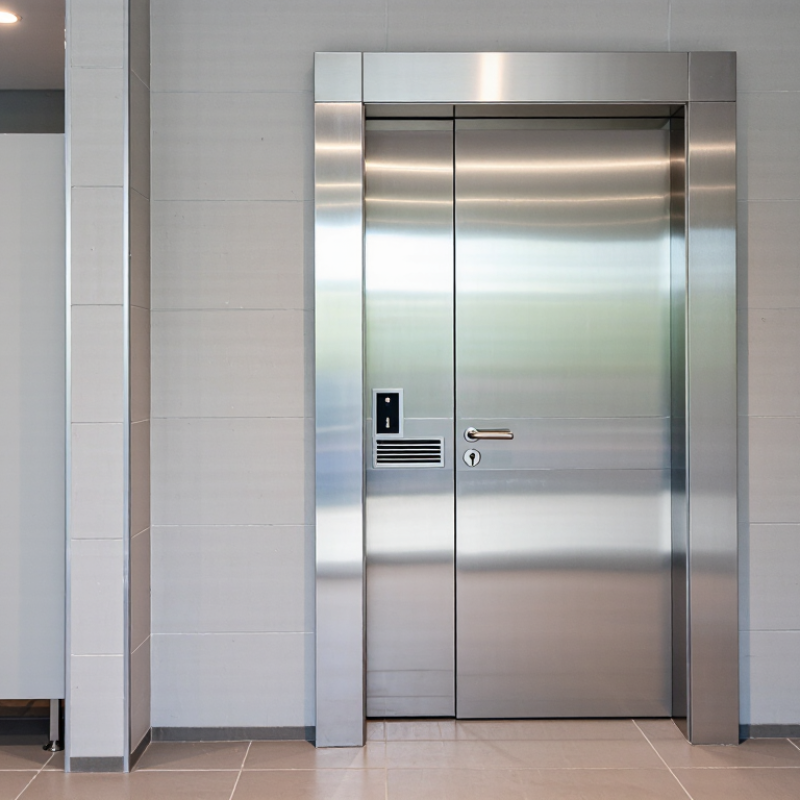
A 32-inch clear opening is a useful accessibility benchmark, but it is not the door leaf width. Measure the passage between the open door face and the opposite frame, including hinges and seals. A wide leaf can still create a narrow route. Check the finished opening after flooring, wall panels, and trim are installed. Small details matter.
Choose a frame that protects the clear width. Thick stops, projecting handles, and poorly positioned closers can reduce usable space. Test the door with a wheelchair-sized approach, not only a tape measure. The swing should not block the accessible route or an adjacent fixture.
Keep thresholds low and firmly fixed. Smooth operation is essential. Pull hardware should feel secure, even with wet hands.
Aluminium resists moisture well, but drainage and surface protection still need attention. Inspect corners, fasteners, and the lower frame for trapped water. Select hinges and closers that support the door without causing excessive opening force. Confirm the required clear width with local accessibility rules and the project inspector; 32 inches is not a universal legal requirement.
On one site, I trusted the drawing and missed a thick wall finish. The installed clearance failed by a small margin. That mistake changed my process: measure the built opening twice, then test a physical sample before ordering.
When selecting a washroom door, examine the frame before admiring its finish. 6063-T5 aluminium is widely used for architectural applications because it offers reliable formability, moderate strength, and strong corrosion resistance. The T5 temper means the extrusion is artificially aged after cooling. This improves its structural performance. Still, alloy grade alone does not guarantee a durable door. Frame thickness, corner joints, and fixing methods matter just as much.
Tip 1: Check the frame profile and wall thickness. A sturdy profile should resist twisting when the door is opened repeatedly.
Tip 2: Ask about surface protection. Anodising or a correctly applied powder coating can reduce staining and protect the aluminium in humid rooms. Small scratches should not expose untreated areas easily.
Tip 3: Inspect drainage details. Water trapped near the bottom rail can damage fittings and create avoidable maintenance problems.
In practical installations, I pay close attention to hinges, screws, and fasteners. Dissimilar metals may cause galvanic corrosion when moisture remains between them. Use compatible hardware and isolate contact points where necessary.
Tip 4: Test the door for movement, not just appearance. It should close without rubbing, sagging, or rattling.
Tip 5: Confirm that the frame suits frequent cleaning. Harsh chemicals can dull finishes, even when the aluminium itself performs well.
I once underestimated hinge alignment; the frame was strong, but the door still felt unstable. That detail deserves more attention.
7 Tips for Choosing an Aluminium Washroom Door
Tip 1: Start with moisture resistance. Washroom doors face splashes, steam, wet floors, and frequent cleaning. The U.S. Environmental Protection Agency notes that mold can develop on damp materials within 24 to 48 hours. Choose a closed-cell, waterproof, or phenolic-based core where moisture exposure is high. Tip 2: Check the door edges carefully. An excellent core can still fail when water enters through unsealed edges, screw holes, or damaged laminate.
Tip 3: Treat fire rating as an assembly requirement. The core alone does not guarantee protection. The leaf, frame, hinges, seals, glazing, and hardware must match the tested system. Look for evidence from tests such as UL 10C or EN 1634-1, with classification reported under EN 13501-2 where applicable. Tip 4: Match the rating to the building specification. NFPA’s Fire Loss in the United States During 2023 reports more than one million fires in the country. That figure is a useful reminder, not a reason to over-specify every washroom door.
Tip 5: Request the test report, not only a sales claim. Tip 6: Confirm whether the rating applies to the actual aluminium frame and opening size. Tip 7: Review moisture and fire documents together. A mineral core may improve fire performance, but it can add weight and complicate installation. A lightweight honeycomb core may handle daily use well, yet provide limited fire resistance. This trade-off is easy to miss. Door selection should reflect the wet environment, evacuation strategy, cleaning routine, and verified test evidence.
| No. | Selection Dimension | Typical Requirement | Suitable Core Direction | Practical Guidance |
|---|---|---|---|---|
| 1 | Identify the moisture zone | Dry public toilet, humid washroom, shower area, or regularly splashed location. | Use moisture-stable, closed-cell, phenolic, or mineral-based options according to the exposure level. | The aluminium facing resists corrosion when properly finished, but exposed edges, joints, cut-outs, and the core still need protection from water ingress. |
| 2 | Match the core to water exposure | Frequent cleaning, high humidity, condensation, or direct water contact. | Prefer closed-cell foam, compact phenolic laminate, or a tested moisture-resistant mineral core. | Avoid untreated paper honeycomb, standard MDF, and ordinary particleboard where water can reach the core; these materials may swell, soften, or lose structural integrity. |
| 3 | Check the required fire rating | No fire-resistance requirement, smoke-control requirement, or a specified rating for a protected opening. | For rated doors, select a mineral or other core that is part of a tested and approved door assembly. | Do not infer a fire rating from the aluminium skin or core material alone. The complete door, frame, seals, hardware, glazing, and installation must be assessed to the applicable code or test standard. |
| 4 | Balance moisture and fire performance | Wet-area durability is needed together with a fire-resistance or reaction-to-fire classification. | Consider a tested mineral-core assembly with sealed edges and compatible wet-area finishes. | A core that performs well in one category may not meet the other. Request evidence for both moisture suitability and the exact fire configuration being specified. |
| 5 | Review edge and hardware details | High traffic, repeated cleaning, cubicle impact, or frequent hinge and latch operation. | Use a dimensionally stable core with reinforced hinge and latch zones where required by the tested design. | Specify sealed or capped edges, corrosion-resistant fixings, suitable gaskets, and hardware compatible with the door thickness and fire-rating requirements. |
| 6 | Compare cleaning and hygiene needs | Daily wiping, disinfectant use, abrasive cleaning, or strict hygiene control. | Choose a smooth, non-absorbent facing and a core that will not readily absorb cleaning moisture if the surface is damaged. | Confirm chemical compatibility of the finish, sealants, and gaskets with the cleaning products used on site. Repair damaged coatings and seals promptly. |
| 7 | Verify documented performance | The project has contractual, regulatory, insurance, or facility-maintenance requirements. | Select only a core and door construction supported by current technical documentation and testing for the intended application. | Ask for water-resistance information, fire-test or classification reports, maximum dimensions, installation limits, maintenance instructions, and confirmation that the supplied components match the tested assembly. |
Note: Fire performance depends on the complete door-set construction and the applicable local building code. Moisture resistance also depends on edge sealing, installation quality, ventilation, and maintenance.
A busy washroom can turn a door into a daily stress test. Check the closer, hinges, pivots, and latch separately. Ask for laboratory evidence, not a sales promise. ANSI/BHMA A156.4 rates Grade 2 door closers at 1,000,000 test cycles, while Grade 1 reaches 2,000,000 cycles. However, that rating applies to the tested closer, not automatically to the complete aluminium door assembly. This distinction is easy to miss.
Tip 1: Request the standard, grade, test date, and cycle result.
Tip 2: Confirm that the hinges and pivots match the expected traffic.
Tip 3: Choose corrosion-resistant aluminium and stainless-steel fasteners for wet cleaning areas.
Tip 4: Check the door’s clear opening and operating force against the project’s accessibility requirements. A strong closer can still feel unpleasant.
Tip 5: Inspect the latch after repeated impact. Loose hardware creates noise, gaps, and repair calls.
The 2024 Global Status Report for Buildings and Construction, published by UNEP and the Global Alliance for Buildings and Construction, highlights the sector’s continuing focus on resource efficiency and building performance. That supports selecting durable, repairable components rather than replacing complete doors.
Tip 6: Prefer replaceable seals, screws, and closer components.
Tip 7: Keep a simple cycle and maintenance log in high-traffic facilities.
One practical warning remains: a million-cycle certificate cannot predict vandalism, poor installation, or harsh cleaning chemicals. Field conditions are less perfect. Verify the installation, too.
Choosing an aluminium washroom door requires more than checking its appearance. In busy offices, a tested 30–35 dB acoustic rating can reduce conversations, flushing sounds, and corridor noise. However, the figure applies to a complete door assembly, not only the aluminium leaf. Ask for laboratory data covering the frame, seals, hinges, and threshold. I have seen attractive doors perform poorly after installers left small gaps around the frame. Details matter.
Ventilation must work with acoustic control. A fully sealed door may improve privacy but trap heat, odours, and moisture inside the washroom. Consider a discreet transfer grille, undercut, or mechanical extract system. Each option changes sound performance. Keep ventilation openings away from direct sightlines where possible. A louver can help airflow, but it may reduce the effective acoustic rating. Request test evidence for the selected configuration, not a similar model. This step is often missed.
Maintenance needs equal attention. Choose corrosion-resistant aluminium finishes and hardware suited to frequent cleaning. Smooth surfaces are easier to wipe near sinks and hand dryers. Use replaceable compression seals. They are inexpensive compared with replacing a complete door. Check hinges and seals during routine inspections. I once focused on the door panel and ignored a worn bottom seal. Noise and draughts appeared within months. That mistake was avoidable. Moisture also collects around poorly drained thresholds, so inspect those areas after cleaning cycles.
No. The important measurement is the clear passage between the open door and the opposite frame. A wide door leaf can still leave a narrow route.
Measure the finished opening after flooring, wall panels, trim, hinges, and seals are installed. Test it with a wheelchair-sized approach. Tape alone can mislead.
Thick stops, projecting handles, and poorly positioned closers may reduce the passage width. Check the actual swing. The route should remain open.
Use a low, firmly fixed threshold. Hinges and closers should support smooth movement without excessive force. Handles must feel secure with wet hands.
Washroom doors face splashes, steam, wet floors, and frequent cleaning. Water can enter through unsealed edges, screw holes, damaged finishes, or lower frames. Inspect corners and drainage paths.
Closed-cell, waterproof, or phenolic-based cores may suit areas with heavy moisture exposure. The core is only part of the protection. Sealed edges still matter.
No. The complete assembly must be tested together, including the leaf, frame, hinges, seals, glazing, and hardware. Request test evidence. Sales claims are not enough.
Match it to the building specification, evacuation plan, opening size, and local requirements. Do not assume every washroom needs the highest rating. Confirm the actual aluminium frame system.
Mineral cores may improve fire performance but add weight and complicate installation. Lightweight honeycomb cores may handle daily use, yet offer limited fire resistance. The compromise needs review.
Do not rely only on drawings. A thick wall finish once reduced the installed clearance unexpectedly. Measure the built opening twice. Test a physical sample before ordering.
Choosing the right Aluminium Washroom Door requires balancing accessibility, durability, safety, privacy, and long-term maintenance. Begin by confirming a minimum 32-inch clear opening where accessible design is required, allowing comfortable passage for users and mobility equipment. For the frame, 6063-T5 aluminium offers a practical combination of structural strength, light weight, and corrosion resistance, making it suitable for humid washroom environments. Door cores should be selected according to moisture exposure, cleaning routines, and applicable fire-rating requirements, rather than appearance alone.
In busy schools, hospitals, transport facilities, and commercial buildings, reliable hardware is equally important. Look for hinges, closers, locks, and pivots tested for at least 1,000,000 cycles to reduce service interruptions. Acoustic performance should also be balanced carefully: a 30–35 dB reduction may improve privacy, but excessive sealing can restrict ventilation and complicate cleaning. The best Aluminium Washroom Door solution combines appropriate sound control with hygienic surfaces, accessible operation, effective airflow, and straightforward maintenance.

Vigor Window